Toddler Hitting or Biting: Calm Scripts & Quick Checklist

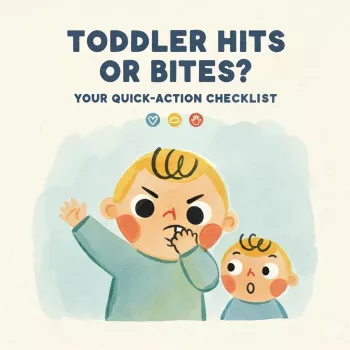
Toddler Hits or Bites? A Quick-Action Checklist for Calm, Firm Boundaries
Hitting and biting can feel shocking and personal, but in toddlerhood it’s usually communication, not “bad behavior.” A consistent, repeatable response helps keep everyone safe while teaching the skills a child doesn’t yet have—impulse control, words for big feelings, and gentle touch.
First, keep everyone safe (the 10-second response)
- Move bodies, not emotions: step between children, gently block hands/teeth, and create a small physical buffer.
- Go low and short: use a calm, low voice and one or two sentences; long explanations often escalate toddlers.
- Comfort the child who was hurt first: check for injuries and offer soothing. This models empathy and reduces reinforcement for the hitter/biter.
- Reset nearby if needed: relocate your toddler to a safe spot close to you (not isolation as punishment—just a supervised reset).
Quick-action checklist by situation
| Situation | Do this now | Say this | Do this later |
|---|---|---|---|
| Bite during play | Separate and remove access for a moment | “I won’t let you bite. Biting hurts.” | Practice “teeth are for food,” offer a teether if sensory need is likely |
| Hit when frustrated | Block the hit; hold hands gently at your side if needed | “I won’t let you hit. You’re mad.” | Teach a replacement: stomp, squeeze a pillow, ask for help |
| Bite when excited/overstimulated | Reduce stimulation; create space and quiet | “Too excited. I’m keeping bodies safe.” | Plan shorter play bursts, more breaks, outdoor movement |
| Aggression at transitions | Pause the transition; offer a clear next step | “Transition is hard. Hands stay gentle.” | Use warnings, visual cues, and a simple choice |
| Bite to protect a toy | Remove the contested item; separate children | “You wanted the toy. Biting is not for toys.” | Coach turn-taking language and offer duplicates when possible |
What to say in the moment (scripts that actually work)
Toddlers respond best to a calm adult who is confident and predictable. The goal is to stop the behavior immediately, name what’s happening, and show what to do instead.
- Name the rule: “I won’t let you hit.” / “I won’t let you bite.”
- Name the feeling or need: “You’re mad.” “You want a turn.” “You need space.”
- State the limit and next step: “I’m moving you over here to keep everyone safe.”
- Offer a replacement: “You can say ‘move please.’” “You can stomp.” “You can squeeze this.”
- Keep repair simple: once calm, prompt: “Check on them—gentle hands,” or “Let’s get ice/a washcloth.”
Why toddlers hit or bite (common triggers to look for)
- Communication gaps: limited language, difficulty asking for turns, or not knowing how to enter play.
- Impulse control: the brain systems for stopping an action are still developing.
- Sensory needs: chewing/pressure-seeking, overstimulation, or fatigue can lower thresholds fast.
- Big feelings: frustration, jealousy, embarrassment, fear, or excitement that spills into the body.
- Environment and routine: hunger, transitions, crowded spaces, or long unstructured play can increase incidents.
For additional guidance on toddler behavior and age-appropriate discipline, the American Academy of Pediatrics (HealthyChildren.org) and the CDC’s Positive Parenting Tips for Toddlers are helpful starting points.
Prevent it next time: set the environment up for success
- Protect high-risk moments: add closer supervision during transitions, playdates, and new settings.
- Reduce triggers early: offer snacks, water, and rest before challenging outings; shorten playdates if needed.
- Pre-teach expectations: “When we’re with friends, mouths are for food. Hands are gentle.”
- Use proximity as prevention: stay within arm’s reach when patterns are emerging.
- Offer sensory outlets: crunchy snacks, age-appropriate chewers/teethers, and “heavy work” like pushing a laundry basket.
Teach replacement skills (what to practice when everyone is calm)
The fastest way to reduce hitting and biting is to teach what to do instead, then practice it in low-stress moments.
- Functional phrases: “Turn please,” “Stop,” “My space,” “Help,” and “All done.”
- Body alternatives: “Hands on your belly,” “Hands in pockets,” “High-five the wall,” “Stomp feet.”
- Role-play for 30–60 seconds: act out wanting a toy and practice words + waiting with a timer.
- Emotion coaching: label feelings in books and daily life to build vocabulary before conflict hits.
- Praise the specific skill: “You were mad and you used your words—nice job keeping hands safe.”
After an incident: repair without shame
Childcare and playdates: align adults on one plan
When to get extra support
A printable plan to keep on hand
- Toddler Hits or Bites? Your Quick-Action Checklist! (eBook download) for short scripts, common triggers, prevention ideas, and a simple tracking page.
- 6-Pack Silicone Baby Safety Socket Covers – European Outlet Childproof Guards to reduce household hazards when you need to focus your attention closely during high-risk moments.
- Mixing Baby Bottles Safely and Easily (eBook) for streamlined routines—because hunger and overtiredness can make toddler behavior spike fast.
FAQ
Is biting normal for toddlers?
Yes—biting is a common toddler behavior, often tied to limited language, immature impulse control, teething/sensory needs, and big feelings like frustration or excitement. It still needs a consistent limit (“I won’t let you bite”) plus teaching a safer replacement.
Should a toddler be punished for hitting or biting?
Harsh punishment and shaming usually backfire by adding more emotion to an already dysregulated moment. A calm, firm boundary, immediate separation for safety, a brief reset, and practicing replacement skills tends to reduce the behavior more effectively over time.
What if my toddler bites at daycare but not at home?
That often points to setting differences like overstimulation, transitions, peer conflict, or fatigue. Align on one consistent response with caregivers and track triggers for a week so prevention (breaks, closer supervision, transition supports) can be targeted.







Leave a comment