Fine Motor Skills Checklist: Easy Printable Activities
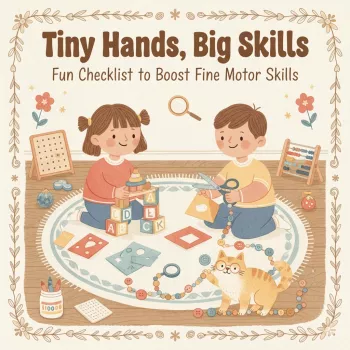
Fine Motor Skills Checklist for Kids: Simple Printable Activities for Home and Classroom
Fine motor skills support everyday tasks like buttoning, cutting, writing, and self-care. A consistent routine of short, playful activities can strengthen hand muscles, coordination, and finger control without turning practice into a struggle. This guide organizes age-aware ideas into an easy checklist format that parents and teachers can use to plan, track, and celebrate progress—especially when time and attention spans are limited.
What Fine Motor Skills Include (and Why They Matter)
“Fine motor” isn’t just handwriting. It’s a bundle of small-muscle skills that help kids use tools, manage clothing fasteners, and participate confidently in school and play.
- Hand strength and endurance: squeezing, pinching, and sustaining grip for tools like crayons and scissors.
- Bilateral coordination: using both hands together (one stabilizes while the other works), important for cutting and dressing.
- Hand–eye coordination: guiding hands based on what the eyes see (threading, placing stickers, tracing).
- In-hand manipulation: moving objects within the hand (shifting a coin to fingertips, rotating a pencil).
- Wrist stability and finger isolation: steady wrist while fingers do precise movements (writing readiness, using tweezers).
- Everyday impact: more independence with zippers, utensils, toothbrushing, and classroom tasks.
For age-expected milestones and a broad view of child development, you can compare skills with resources like the CDC Milestone Checklists and guidance from HealthyChildren.org (American Academy of Pediatrics).
Getting Started: A Checklist Routine That Actually Sticks
Progress is more likely when practice feels predictable, quick, and winnable. A checklist helps adults stay consistent and helps kids see that effort adds up.
- Choose 3–5 activities per week and repeat them to build confidence before adding variety.
- Keep sessions short: 5–10 minutes is often enough for preschool and early elementary.
- Pair practice with a daily anchor: after snack, before storytime, or as a warm-up before homework.
- Use simple tracking: “tried it,” “needed help,” “did it independently,” rather than perfect results.
- Rotate tools to stay playful: crayons, chalk, clothespins, tongs, stickers, hole punch, kid scissors.
- Aim for balance: include both strength (pinch/squeeze) and precision (place/trace) across the week.
Weekly Fine Motor Checklist (Example)
| Activity | Skills Practiced | Time | Materials | Track (Mon–Fri) |
|---|---|---|---|---|
| Playdough pinch-and-roll | Pinch strength, finger isolation | 5–8 min | Playdough | □ □ □ □ □ |
| Sticker dot targets | Pincer grasp, hand–eye coordination | 5 min | Stickers, paper | □ □ □ □ □ |
| Clothespin color match | Grip strength, bilateral coordination | 5–10 min | Clothespins, cups | □ □ □ □ □ |
| Cut along thick lines | Scissor control, bilateral coordination | 5–10 min | Kid scissors, strips | □ □ □ □ □ |
| Bead threading (large to small) | Coordination, in-hand manipulation | 5–10 min | Beads, lace | □ □ □ □ □ |
Printable-Style Activity Ideas (Low-Prep, High Repetition)
These activities mimic “printable” stations while staying flexible (you can draw targets on paper, use index cards, or slip pages into a dry-erase sleeve).
- Dot marker paths: fill circles left to right to encourage directionality and controlled pressing.
- Trace-and-erase cards: trace simple shapes, then erase to build wrist stability and endurance.
- Cutting strips ladder: progress from snips to straight lines to gentle curves.
- Glue control pages: place tiny dots of glue, then press small paper squares or pom-poms onto targets.
- Stamp patterns: copy AB, AAB, and ABC patterns to blend fine motor work with early math.
- Maze or road maps: drive a toy car or trace a marker line while staying inside boundaries.
- Lacing cards: start with fewer, larger holes and increase density as coordination improves.
If you want a ready-to-use set that removes the setup step, the Fine Motor Skills Checklist printable (digital download) can be used for home practice or classroom centers and makes it easy to track progress week to week.
Household Activities That Build the Same Skills
Fine motor practice doesn’t have to look like “work.” Everyday routines offer natural repetition and real-life motivation.
For a simple “station” that encourages kids to pick up and put away tools independently, a desktop caddy can help. The Metal Pen & Pencil Organizer works well for crayons, short pencils, kid scissors, dot markers, and glue sticks.
Adapting Activities for Different Ages and Abilities
When questions come up about skill-building supports at school or home, the American Occupational Therapy Association (AOTA) offers helpful context on how occupational therapy supports children and youth.
Motivation and Progress Tracking Without Pressure
Printable Checklist Pack Option (Digital Download)
For a streamlined option that’s easy to share between caregivers and teachers, use the Fun Checklist to Boost Fine Motor Skills (Printable Activities for Kids) as a consistent routine that travels between home and school.
FAQ
How often should kids practice fine motor activities?
Short, consistent practice tends to work best: about 5–10 minutes most days or 3–5 times per week. Repeating the same few activities for a week or two can build confidence, and it’s fine to stop early if fatigue or frustration spikes.
What are the best fine motor activities for preschoolers?
Mix strength and precision: playdough pinch/roll, sticker targets, clothespins, tong transfers, bead threading with large beads, dot markers, and simple snipping. Keep targets big, tools easy to grasp, and sessions brief.
When should a parent or teacher seek extra support for fine motor skills?
Consider extra support if a child consistently struggles with age-expected tasks (utensils, buttons, coloring/cutting), avoids fine motor activities, or shows pain, extreme fatigue, or very awkward grasp. If progress is limited despite steady practice, discussing concerns with a pediatrician or occupational therapist can clarify next steps.









Leave a comment